1

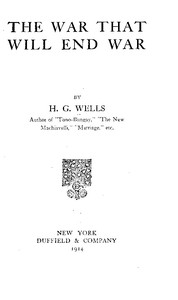
The War That Will End War — A Closer Reading
24
5
Project Gutenberg
2018
World War, 1914-1918
Readers of public-domain and historical texts
Project Gutenberg digital edition
en
Edition facts
Words: 26,070
Reading time: 114 min
Text sections: 13
Source:
Project Gutenberg record #57481
H.G. Wells's 1914 essay collection argues Britain's entry into World War I is a fight against German militarism, urging readers to see the conflict as an opportunity to reshape Europe through liberal internationalism and collective disarmament.
Editorial Edition Score
4.7/5
★★★★★
★★★★★
Calculated from edition completeness, EPUB availability, text structure and catalogue metadata. Not a user rating.
Edition quality
H.G. Wells opens The War That Will End War with a sharp distinction between the cause and the object of the conflict. He states plainly that Britain entered the war because of its treaty obligations to Belgium, not out of interest in France's eastern frontier. But once engaged, he insists, the war must become a mortal struggle against German Imperialism, not a limited diplomatic settlement. This initial chapter sets a tone of urgent, reasoned argument, blending legal analysis with a call for total victory.
A War of Peoples, Not Soldiers
Wells repeatedly emphasizes that this is a war of whole populations, not just armies. He quotes Mr. Sidney Low to reinforce that the conflict touches every man and home. This framing allows him to argue that the war demands a thorough reckoning, not a negotiated peace that leaves German Imperialism intact. The language is direct and uncompromising, reflecting the early-war conviction that only total defeat of the enemy can secure lasting peace.
The Collapse of Old Certainties
In a later chapter, Wells describes the rapid dissolution of pre-war social and economic norms. He observes that ideas once considered divine truths—such as the rights of property and individualism—are being abandoned as the state takes over food supply and railways. He notes that even shareholders do not object. This passage captures the sense of radical transformation, where the war has made collectivism and state control suddenly acceptable. Wells presents this not as prophecy but as observation of immediate events.
The Opportunity for Liberal Ideas
Wells sees the crisis as a test for liberal thought. He asks whether liberals can produce and express ideas that will rule the new world, or whether they will be swept aside by brute accident. He calls for planning the confederation and collective disarmament of Europe now, while the map can be redrawn. This section reveals his belief that will and ideas can shape the future, and that the moment demands constructive action from those who know what they want.
A Call to American Readers
In an appeal to the American people, Wells argues that the war is not merely a European affair but a global struggle for freedom. He urges the United States to recognize the stakes and support the cause of liberal internationalism. This section broadens the book's audience, showing Wells's awareness of the war's transatlantic dimensions and his hope for American involvement in shaping the post-war order.
Readers approaching The War That Will End War should note that it is a collection of essays written in the heat of 1914, not a retrospective analysis. Wells's arguments are shaped by the urgency of the moment, and his predictions are necessarily provisional. The book offers a window into the mindset of a prominent intellectual grappling with the outbreak of a world war, and it rewards attention to the specific rhetorical strategies he employs to persuade his contemporaries.
Reader reflection
How will you remember this book?
Save your reaction, strongest insight, and memorable passage.
Your progress
0
/
10
2
Did this book hold your interest?
3
Would you encourage someone else to read it?
4
How much effort did this book require?
5
Would you read this book again?
6
How well did it match your expectations?
7
How strong was your personal connection to the text?
8
How clearly were the main ideas presented?
9
What is the main idea you are taking away?
10