1

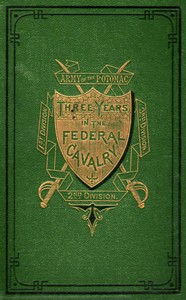
Three Years in the Federal Cavalry — Context and Discussion
16
2
Project Gutenberg
2009
United States -- History -- Civil War, 1861-1865 -- Personal narratives
Readers of public-domain and historical texts
Project Gutenberg digital edition
en
Edition facts
Words: 84,666
Reading time: 369 min
Text sections: 12
Source:
Project Gutenberg record #29660
Willard Glazier's memoir of cavalry service in the Army of the Potomac, drawn from his wartime diary. The narrative shifts between rapid-action raid sequences and reflective camp scenes, with a voice that balances soldierly grit and patriotic sentiment.
Editorial Edition Score
4.9/5
★★★★★
★★★★★
Calculated from edition completeness, EPUB availability, text structure and catalogue metadata. Not a user rating.
Edition quality
Willard Glazier's Three Years in the Federal Cavalry opens not with a grand proclamation but with a practical note: the author kept a daily journal during the campaigns of the Army of the Potomac, and from that diary this account is compiled. The preface acknowledges that many engagements, though vivid to participants, may seem too brief on the page—a frank admission that shapes the reader's expectations. What follows is a narrative that alternates between the swift, episodic rhythm of raids and the slower, more reflective pace of camp life, creating a distinctive cadence that mirrors the cavalryman's experience.
Diary-Driven Narrative and Its Effects
Glazier explicitly states that his story is compiled from a journal kept during the campaigns. This origin is evident in the text's structure: entries are often dated (e.g., "May 6."), and the prose moves in short, declarative bursts that record events as they happen. The diary format lends immediacy to descriptions of captures and skirmishes, but it also means that the narrative can feel episodic, jumping from one action to the next without extensive reflection. For instance, the capture of a Rebel wagon train is noted matter-of-factly: "After appropriating a generous supply for the day, the remnant was reduced to ashes." The reader is left to infer the emotional weight from the spare language. This technique creates a sense of authenticity but also leaves gaps where a more reflective memoir might linger.
Pace Shifts Between Action and Lull
The narrative's pace is far from uniform. During raid sequences, the prose accelerates: columns press onward through rain, ferry crossings are "tedious," and bushwhackers fire from thickets. Glazier uses short, stacked clauses to convey urgency: "Cold, hungry, and fatigued, we still pressed onward, suffering not a little." In contrast, camp-life sections slow to a more deliberate tempo, describing unmilitary appearances, the bugle corps, and the mail-bag. This alternation between rapid movement and static waiting is a structural feature of cavalry service itself, and Glazier's text reproduces it faithfully. The reader experiences the same jarring transition from the quiet of a bivouac to the chaos of a surprise encounter, as when a body of cavalry appears at dusk and shots are exchanged before the mistake is discovered.
Voice: Soldierly Directness and Patriotic Framing
Glazier's narrative voice is that of a soldier who sees his duty clearly. He describes the capture of supplies with a practical tone—"just the prize we coveted"—and notes the destruction of property without moral hand-wringing. Yet this directness is periodically overlaid with patriotic sentiment, as when he compares his comrades' feelings to those of Napoleon's legions: "The eyes of all Europe are upon you." The juxtaposition is striking: the same paragraph that invokes Napoleon also mentions the possibility of ending up in "Libby" or "Belle Isle." This blend of high-flown rhetoric and grim reality gives the voice a dual character—part official chronicle, part private soldier's account. The reader must navigate between these registers, recognizing that the author is both participant and memorialist.
Readers will find that the book's value lies less in strategic analysis than in its accumulation of small, concrete details: the one-horse ferry, the captured ham and eggs, the horses killed to prevent capture. Glazier's diary-based method preserves these moments with a fidelity that a more polished memoir might lose. Approaching the text as a document of lived experience—with all its abrupt transitions and uneven pacing—allows its particular texture to emerge.
Reader reflection
Record your reading impressions
A brief reflection can help important ideas stay with you longer.
Your progress
0
/
10
2
Did this book hold your interest?
3
Would you pass this book on to a friend?
4
How easy was the book to follow?
5
Is this a title worth rereading?
6
How clear did the writing feel?
7
How much did the book move you?
8
Did the book give you something worth debating?
9
In one sentence, what did you learn?
10