1

Over the Seas for Uncle Sam — Reading Companion
18
4
Project Gutenberg
2012
World War, 1914-1918 -- Personal narratives, American
Readers of public-domain and historical texts
Project Gutenberg digital edition
en
Edition facts
Words: 40,744
Reading time: 178 min
Text sections: 5
Source:
Project Gutenberg record #41324
Elaine Sterne's 1918 collection of firsthand American naval and army narratives from World War I, compiled while she served in hospital relief. The excerpts show raw soldier slang, mud-soaked trench details, and a focus on ordinary men becoming heroes.
Editorial Edition Score
4.7/5
★★★★★
★★★★★
Calculated from edition completeness, EPUB availability, text structure and catalogue metadata. Not a user rating.
Edition quality
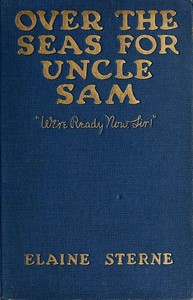
Elaine Sterne's Over the Seas for Uncle Sam opens with a striking declaration: “Only the hits count!” This motto, paired with the Navy slogan “We're ready now!”, sets a tone of blunt, unsentimental patriotism. Sterne, a first lieutenant in the Girls' National Honor Guard, compiled these narratives while working in hospital relief, and her preface frames the book as a revelation of ordinary men's heroism. The excerpts reveal a voice that is colloquial and immediate, with soldiers describing trenches as “knee-deep slime” and measuring distance by “increasing volume” of cannon fire. The language is unpolished, full of dashes and exclamations, suggesting Sterne preserved the raw quality of her sources.
Colloquial Voice and Soldier Slang
The excerpts are marked by a distinctly informal, spoken quality. Phrases like “I guess not!—freights” and “By God! I knew it then!” convey the immediacy of oral testimony. Soldiers refer to enemies as “Huns” and describe exhaustion with understatement: “you didn't have energy enough left to open them.” The narrative voice shifts between first-person plural (“We piled in”) and singular (“I had to stand watch”), creating a sense of shared experience punctuated by individual shock. Sterne likely edited these accounts lightly, preserving the vernacular to maintain authenticity.
Sensory Details of the Trenches
The physical environment is rendered through relentless sensory detail: mud that goes “up to our waists,” a “cold, driving rain straight down from the black sky,” and the “dull, thick booming” of cannons. The narrator notes that “all the mud I had ever read about seemed to be planted in that trench,” a self-aware nod to the gap between expectation and reality. Dugouts are described as places where one could “set up your cook-stove if you were lucky enough to own one,” and food is carried “on your back in cans.” These specifics ground the narrative in the material hardships of war.
Structure: Abrupt Transitions and Elliptical Storytelling
The excerpts move in short, punchy paragraphs, often jumping between scenes without transition. A line like “A long line of troop trains were awaiting us. Pullmans? I guess not!—freights” uses a question-answer rhythm to mimic spoken storytelling. The narrative frequently trails off: “What became of him I never knew. You don't, most of the time.” This elliptical style reflects the fragmentary nature of memory and the chaos of war, where events blur and comrades disappear without resolution.
Recurring Motif: The Ordinary Man as Hero
Sterne's preface explicitly frames the book as a discovery that “our own fathers and brothers and husbands and lovers are potential heroes.” The excerpts reinforce this by emphasizing the civilian backgrounds of the soldiers: “we fellows who had been so recently in offices plugging away for so much a week.” The narrative dwells on the transformation from office worker to trench fighter, noting that “you don't worry about dying” but “the one thing that gets you is when your best pals go west.” This focus on camaraderie and loss, rather than tactical detail, aligns with Sterne's stated aim to reveal the human side of war.
Readers should approach Over the Seas for Uncle Sam as a curated collection of oral histories rather than a unified memoir. Sterne's editorial hand is light, allowing the soldiers' own rhythms—their slang, their silences, their sudden bursts of emotion—to shape the narrative. The book offers a valuable record of how American and Canadian volunteers described their experiences in the moment, before the war became mythologized. Pay attention to what is left unsaid: the gaps, the unfinished sentences, the moments where language fails.
Reader reflection
What was your reading experience?
Capture what you thought, learned, and would like to remember.
Your progress
0
/
10
2
What was your overall reaction to the book?
3
Would you encourage someone else to read it?
4
How demanding did the text feel?
5
How distinctive were its ideas or approach?
6
How did the pace of the book feel?
7
Did any part of the book feel personally relevant?
8
Could you apply anything you learned?
9
What did this book teach you most?
10