1

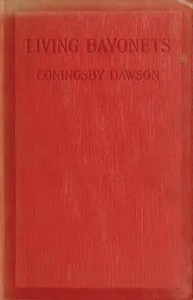
Living Bayonets: A Record of the Last Push — Inside the Classic
8
1
Project Gutenberg
2016
World War, 1914-1918 -- Personal narratives, English
Readers of public-domain and historical texts
Project Gutenberg digital edition
en
Edition facts
Words: 52,142
Reading time: 227 min
Text sections: 5
Source:
Project Gutenberg record #52451
Coningsby Dawson's letters from the Western Front, edited by his sister, capture the tension between domestic longing and combat duty, the shift in American sentiment after entering WWI, and the soldier's pride in a humble role over literary ambition.
Editorial Edition Score
4.7/5
★★★★★
★★★★★
Calculated from edition completeness, EPUB availability, text structure and catalogue metadata. Not a user rating.
Edition quality
Coningsby Dawson's letters, edited by his sister Muriel and published as a sequel to Khaki Courage, open with the writer lighting a candle in a bunk recently vacated by a German soldier. The date is April 14, 1917, and America has just entered the war. Dawson's voice immediately registers the shift: he imagines returning to New York in khaki, no longer slinking in as a civilian. The letters are not retrospective; they are written in the moment, from dugouts, cottages, and saddle, with the guns audible in the background.
Domestic Intimacy Amid Gunfire
Dawson's letters weave together the mundane and the violent. In one passage, he describes the smell of sweet myrtle drifting through a cottage window, mixed with the croaking of frogs and the distant pounding of guns. He writes of a toddler named Tinker who refuses to sleep until he kisses her goodnight; after he leaves, the family pretends he is entering the hall to calm her. These details—a child pointing to the window and saying “Dorn walk in park”—ground the narrative in a specific, affectionate domesticity that contrasts sharply with the surrounding war. Dawson notes that the love of a little child is more truthful than that of a woman, and he cannot lie to her. The letters thus become a record of how a soldier maintains emotional continuity with home while facing an uncertain future.
Pride in Soldiering Over Writing
Dawson repeatedly measures his worth by his military role, not his literary career. In a letter from May 1918, he states flatly: “I'm only a subaltern—and far prouder to be that than a writer.” He adds that he is estimated by none but his soldiering qualities and “power to show guts.” This self-assessment is not false modesty; it reflects a deliberate reordering of priorities. Earlier, he contrasts his former self with Hamlet, thinking himself into “a green sickness,” and now sees life in “courageous vistas of actions.” The letters document a man who has shed literary ambition for a simpler, more dangerous code. The editor's foreword notes that these letters were published in response to requests from readers of Khaki Courage, suggesting that Dawson's transformation resonated with a public eager for authentic soldier testimony.
The Moral Weight of America's Entry
Dawson's April 1917 letter treats America's declaration of war as a personal and moral turning point. He writes that the “moral advantage” of having the United States as an ally is “the greatest wound to the spirit of Germany that she has received since the war started.” He imagines New York and the Hudson as “just across the lawn from England,” a striking spatial compression that conveys emotional proximity. The letter also reveals a shift in public sentiment: Dawson is glad that his family feels as they do about his returning to the Front, and he expresses relief that the “cloud of reproach” has lifted. His tone is almost gay, and he predicts that America will go “baldheadedly for war.” This section of the correspondence captures a specific historical moment—April 1917—when the war's moral calculus changed for many English-speaking soldiers.
Dawson's letters resist easy categorization: they are neither pure combat report nor sentimental home-front narrative. Readers will find a writer who is acutely aware of his dual identity as soldier and correspondent, and who uses the letter form to bridge those worlds. The editor has preserved the original sequence and dates, allowing the reader to trace Dawson's shifting moods across the final push of the war. Pay attention to the recurring sensory details—smells, sounds, the texture of a sleeping-sack on a tiled floor—as they often carry more weight than the strategic commentary.
Reader reflection
What did you think of this book?
Answer a few questions and save a private reflection on this device.
Your progress
0
/
10
2
Did this book hold your interest?
3
Would you recommend this book to another reader?
4
How demanding did the text feel?
5
Which part made the strongest impression?
6
How would you describe its reading pace?
7
Did the book offer a fresh perspective?
8
How understandable was the text?
9
What changed or sharpened your thinking?
10