1

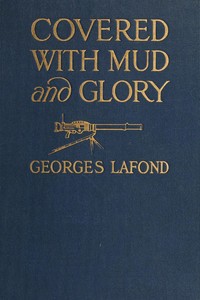
Covered with mud and glory — Reading Companion
24
4
Project Gutenberg
2019
World War, 1914-1918 -- Personal narratives, French
Readers of public-domain and historical texts
Project Gutenberg digital edition
en
Edition facts
Words: 53,721
Reading time: 234 min
Text sections: 8
Source:
Project Gutenberg record #60268
A machine-gun sergeant's firsthand account of trench warfare on the Somme and Aisne, blending technical detail with dark humor and camaraderie, as seen through episodes like Marseille's daring soup-rescue mission.
Editorial Edition Score
4.7/5
★★★★★
★★★★★
Calculated from edition completeness, EPUB availability, text structure and catalogue metadata. Not a user rating.
Edition quality
Georges Lafond, a sergeant-major in the French Territorial Hussars and later an intelligence officer with machine-gun sections, wrote this account from the front lines of World War I. The book opens with a striking image: a soldier hit, captured in the moment by Sergeant Lace's cry. Lafond's narrative is grounded in the gritty specifics of machine-gun operation—the Saint Etienne model, the belts, the barrel—and the precarious logistics of keeping troops fed under fire. The dedication to fallen comrades of the second company of machine guns sets a tone of personal loss and shared experience.
Mud, Glory, and the Machine Gunner's Craft
Lafond's account is notable for its technical precision. He describes the Saint Etienne machine gun not as a distant weapon but as a tool intimately known: its barrel, belts, and the rhythm of its fire. In one episode, a soldier named Marseille borrows the lieutenant's gun, wraps it in canvas, and crawls out to a ruined hut to provide covering fire for a fatigue party carrying soup. The gun's 'irregular tap-tap' becomes a lifeline. This blend of mechanical detail and tactical improvisation is a recurring pattern, showing how soldiers adapted their equipment to the chaotic demands of trench warfare.
Marseille: The Voice of Irreverent Resilience
Among the most vivid passages is the story of Marseille, a soldier who arrives late from leave with a flippant excuse: 'I don’t like to travel alone. I like society, I do.' His confidence is infectious. When the mess corporal fears the soup won't get through, Marseille assures him, 'You’ll be all right, mon vieux. You’ll get there.' He then orchestrates a daring rescue, using a machine gun to distract the Germans while the cooks dash to safety. His singing voice, 'as clear as the sunny lights of La Corniche,' contrasts sharply with the surrounding mud and shellfire. Such moments of humor and defiance punctuate the narrative, offering a counterpoint to the grim reality of war.
Clemenceau's Tribute and the Texture of the Front
The book includes a prefatory tribute by Georges Clemenceau, who observes the 'blue-uniformed men at war' as they pass 'generously covered with mud.' He notes their 'colorless and shapeless uniforms' and the way officers are 'hardly to be distinguished from privates by vague, soiled stripes.' Clemenceau's language—'picturesque because nature will have it so, but without any romanticism'—echoes Lafond's own unsentimental eye. The text is filled with such details: the 'glistening slope of soaked earth,' 'shattered trees twisted into indescribable convulsions,' and the shared bucket of wine abandoned by the fatigue party. These sensory fragments build a world where glory is inseparable from mud.
Readers should approach Covered with Mud and Glory as a mosaic of frontline vignettes rather than a continuous narrative. Lafond's voice is that of a participant-observer, attentive to both the machinery of war and the personalities who operate it. The book rewards those who read for specific, grounded observations—how a gun is cleaned, how a joke is told under shellfire, how a comrade's singing cuts through the noise. Clemenceau's framing reminds us that these men were 'less aware of historic grandeur than of serene gladness in implacable duty.'
Reader reflection
How did this book work for you?
Your answers remain private and are stored only in this browser.
Your progress
0
/
10
2
Did this book hold your interest?
3
Would you encourage someone else to read it?
4
How demanding did the text feel?
5
Did anything about the book feel genuinely new?
6
Would you read this book again?
7
Did any part of the book stay with you emotionally?
8
Would you start a conversation about this book?
9
What changed or sharpened your thinking?
10