
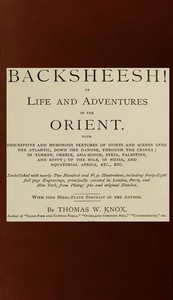
The Story Teller of the Desert—"Backsheesh!" by Thomas Wallace Knox
Published in 1875, Thomas Wallace Knox's book is a unique blend of travelogue and social observation. Knox was a real-life war correspondent and world traveler, and he pours that firsthand experience into this work. It reads like a series of vivid snapshots from a journey most of his readers could only dream of.
The Story
The book follows an unnamed American traveler (clearly based on Knox himself) as he encounters a traditional storyteller, a hakawati, in a desert setting. Eager to hear a local legend or folktale, the traveler settles in. However, the storytelling is constantly interrupted. Just as the plot thickens or a character is introduced, the hakawati pauses, extends his hand, and utters the pivotal word: 'Backsheesh!' This demand for a gratuity becomes the central rhythm of their interaction. The traveler must repeatedly pay to keep the story moving, leading to negotiations, frustrations, and moments of humor. It's less about the specific tale being told and more about the transactional relationship between storyteller and audience, and between Western curiosity and local custom.
Why You Should Read It
What grabbed me wasn't a sweeping plot, but the book's cleverness. On the surface, it's a funny account of a cultural clash. But look closer, and it's a sharp commentary on the economics of storytelling and cultural exchange. Knox is asking us: When we seek 'authentic' experiences from other cultures, what are we willing to pay for them? Are we listeners or consumers? The hakawati isn't a passive source of folklore; he's an entrepreneur in control of his craft. This dynamic feels surprisingly modern. In an age where we constantly 'consume' stories, Knox makes you pause and consider the value we assign to them.
Final Verdict
This is a gem for readers who enjoy historical travel writing with a point of view. It's perfect if you like the adventurous spirit of 19th-century explorers but want something more layered than a simple geography lesson. If you're interested in cultural anthropology, media, or just a smart, short book that makes you think about how stories are told and sold, you'll find 'Backsheesh!' incredibly rewarding. It's a quick, insightful peek into a world where every story has its price.
This content is free to share and distribute. You do not need permission to reproduce this work.
Michael Harris
4 months agoThanks for the recommendation.
Kevin Lewis
1 year agoAfter finishing this book, the flow of the text seems very fluid. I will read more from this author.
Logan Lewis
11 months agoAfter finishing this book, the plot twists are genuinely surprising. Highly recommended.
Deborah Allen
1 year agoThe formatting on this digital edition is flawless.






Paul Smith
1 year agoRight from the opening paragraph, the historical context mentioned in the early chapters is quite enlightening. I'll be citing this in my upcoming project.