1

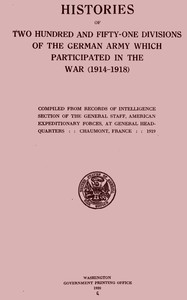
Histories of two hundred and fifty-one divisions of the German army which participated in the war (1914-1918) — Text and Context
16
1
Project Gutenberg
2017
World War, 1914-1918 -- Germany; Germany. Heer -- History -- World War, 1914-1918
Readers of public-domain and historical texts
Project Gutenberg digital edition
en
Edition facts
Words: 242,212
Reading time: 1054 min
Text sections: 254
Source:
Project Gutenberg record #55620
A U.S. War Department intelligence compilation of 251 German division histories from WWI, structured as standardized entries tracking each unit's movements, engagements, and organizational changes across the Western Front.
Editorial Edition Score
4.9/5
★★★★★
★★★★★
Calculated from edition completeness, EPUB availability, text structure and catalogue metadata. Not a user rating.
Edition quality
This volume, compiled in 1919 by the Intelligence Section of the American Expeditionary Forces' General Staff, presents 251 discrete histories of German army divisions that served in World War I. Each entry follows a rigid template: a table of subordinate regiments and support units, followed by a chronological narrative of the division's movements and battles, often broken into year-by-year or sector-by-sector subsections. The work is a reference tool, not a narrative history; its value lies in the systematic, data-dense presentation of unit locations, casualties, and reorganizations as observed by Allied intelligence.
Standardized Entry Structure
Every division history opens with a table listing its constituent infantry regiments, cavalry, artillery, engineers, medical units, and transport columns. For example, the 28th Reserve Division’s entry includes entries for the 40th and 109th Reserve Infantry Regiments, the 8th Reserve Dragoons, and the 29th Reserve Field Artillery Regiment. The tables use consistent abbreviations (e.g., “Res.” for Reserve, “Ldw.” for Landwehr, “Ers.” for Ersatz) and often note when units were attached or detached. This uniformity allows quick comparison across divisions, but the tables also reveal the frequent reorganization of German units—the 28th Reserve Division lost its 40th Reserve Infantry Regiment to the 115th Division in April 1915, a change recorded in both the table and the narrative.
Chronological Movement and Battle Tracking
The narrative sections trace each division’s path through the war in a terse, factual style. The 28th Reserve Division’s history, for instance, begins with its formation in Baden and moves through engagements in the Vosges (August 1914), the Somme (1915–1916), Champagne (July–October 1916), and Verdun (late 1916). Dates and locations are precise: “detraining near Emmendingen (Baden), entered Alsace by way of Markolsheim on August 10.” The entries often note the division’s assignment to specific armies (e.g., 7th Army under Von Heeringen) and the sectors it held, such as “the sector crossed by the Albert-Bapaume road (Ovillers to Fricourt).” Casualty figures appear sparingly but starkly: the 111th Reserve Infantry Regiment lost “39 officers and 1,821 men” on July 1, 1916.
Recurring Patterns of Relief and Reorganization
A striking feature across entries is the frequency with which divisions were rotated out of the front line for rest and reconstitution. The 28th Reserve Division, after heavy losses on July 1, 1916, was “withdrawn from the front, sent to rest, and reorganized” by July 4. It then moved to Champagne, then back to the Somme in October, then to the Stenay area, and finally to Verdun. Such rapid redeployment—sometimes within weeks—reflects the German army’s operational tempo. The entries also document changes in division composition: the 28th lost its Jäger battalions in early 1915 and gained new engineer and signal units later. These details, while dry, build a picture of a military machine constantly patching itself together.
Limits of the Intelligence Perspective
The compilers worked from Allied intelligence records, which inevitably shaped what was recorded. The entries focus on observable events: troop movements, battle participation, and unit assignments. They rarely mention German command decisions, morale, or strategic intent. For instance, the 28th Reserve Division’s history notes that its “combat activity was weak” between October 1915 and July 1916, but offers no explanation. Similarly, the narrative treats the division’s transfer to Champagne as a simple fact, without discussing the broader German offensive plans. Readers should treat these histories as operational logs rather than comprehensive accounts; they are invaluable for tracking where divisions were and when, but silent on why.
This compilation is best used as a reference for tracing the movements of specific German divisions across the Western Front. Its standardized format makes it easy to compare units, but the lack of context or analysis means it should be supplemented with other sources for a fuller picture of the war. The work’s origin as an intelligence document also means it reflects the priorities and limitations of Allied observation—a point worth keeping in mind when consulting its entries.
Reader reflection
Your personal reading reflection
Build a private reading journal entry for this title.
Your progress
0
/
10
2
What was your overall reaction to the book?
3
Is this a title you would suggest to others?
4
How much effort did this book require?
5
How distinctive were its ideas or approach?
6
Could you follow the author’s main argument?
7
Did you gain anything practical from the text?
8
How strong was your personal connection to the text?
9
What changed or sharpened your thinking?
10