1

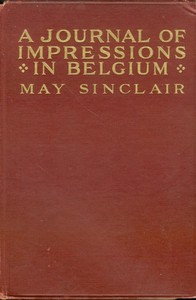
A Journal of Impressions in Belgium — Reading Notes
15
1
Project Gutenberg
2010
World War, 1914-1918 -- Personal narratives
Readers of public-domain and historical texts
Project Gutenberg digital edition
en
Edition facts
Words: 72,410
Reading time: 315 min
Text sections: 7
Source:
Project Gutenberg record #31332
May Sinclair's 1915 diary of her brief time with a field ambulance unit in Belgium, focusing on psychological impressions rather than military facts, and revealing the tension between her desire for danger and her actual role.
May Sinclair opens her journal with a dedication poem that immediately establishes the book's central tension: she addresses the field ambulance men as those who 'did what I only dreamed.' This confession of inadequacy, paired with her vivid description of danger as a 'Huntress who flies before her quarry,' sets the tone for a record that is self-consciously subjective. Sinclair warns readers in her introduction that this is 'nothing more' than a 'Journal of Impressions,' and that those seeking solid facts should look elsewhere. The excerpts bear this out: she records not troop movements but the strange sight of clean glasses surviving in a shattered inn, and the transformation of a Quaker pacifist into a cheerful gunner.
The Quaker Turned Gunner
One of the most striking passages in the excerpts describes a former Quaker pacifist who now commands an armoured car. Sinclair notes his face has turned 'the colour of copper'—not the gentle copper of arts-and-crafts, but a 'truculent, damn-disarmament, Krupp-&-Co., bloody, ammunition copper.' The transformation is complete: he drinks whisky, swears like an able seaman, and has spent the afternoon 'potting Germans.' Sinclair's observation that 'no man could possibly be happier than this Quaker is now' undercuts any simple moral about war's horrors. The armoured car itself is a comic contraption: an ordinary touring car surrounded by 'mere matchboard' painted grey, with holes for machine-guns. When asked about its lack of protection, the crew replies it is 'for attack, not defence.' Sinclair captures the absurdity and the bravado without judgment, letting the details speak.
The Unbroken Glasses
In a ruined inn near Baerlaere, Sinclair and her companions find a table where 'a row of clean glasses still stood in their order as the landlord had left them; and not one of them was broken.' This small, precise image—amid wrecked walls and furniture—becomes a symbol of the ordinary persisting through catastrophe. Sinclair does not editorialize; she simply records the fact. The moment is framed by a comic episode: after the group runs back to the car, Mr. L. reproves Mr. M. for 'taking a lady into danger,' while Sinclair thinks it would be undignified to duck if shells came. The juxtaposition of the fragile glasses and the absurd concern for propriety reveals Sinclair's eye for the incongruous details that official histories omit.
The Limits of the Journal Form
Sinclair's introduction insists that many impressions were 'insubstantial to the last degree' and that few were set down on the spot. The excerpts show her working within these limits: she records what she saw and heard, but often without context or resolution. The soldiers are 'not particularly pleased' at the car's noise near their trench, but the incident passes without consequence. The evening entry at the 'Flandria' notes that Ursula Dearmer has been sent to Zele, but Sinclair does not explain why or what happens there. These gaps are not failures; they are the honest shape of a journal that refuses to fabricate coherence. Readers must accept that this is a partial, temperamental record—one that values psychological accuracy over completeness.
Sinclair's journal rewards readers who attend to its small, odd details: the unbroken glasses, the copper-faced Quaker, the matchboard car. She does not explain or moralize; she presents and moves on. The book is best approached not as a source of facts about the war, but as a document of how one writer's mind processed proximity to violence—with irony, self-deprecation, and a sharp eye for the absurd. Let the gaps stand; they are part of the record.
Reader reflection
How did this book work for you?
Your answers remain private and are stored only in this browser.
Your progress
0
/
10
2
Did this book hold your interest?
3
Is this a title you would suggest to others?
4
How much effort did this book require?
5
Which part made the strongest impression?
6
Is this a title worth rereading?
7
Did you relate to its people, ideas, or situations?
8
Could you apply anything you learned?
9
In one sentence, what did you learn?
10