1

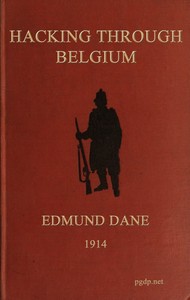
Hacking Through Belgium — A Closer Reading
16
1
Project Gutenberg
2018
World War, 1914-1918 -- Campaigns -- Western Front
Readers of public-domain and historical texts
Project Gutenberg digital edition
en
Edition facts
Words: 37,728
Reading time: 165 min
Text sections: 15
Source:
Project Gutenberg record #56661
Edmund Dane's 1914 account of Belgium's resistance in WWI, focusing on the moral and military impact of the 'scrap of paper,' the German occupation of Brussels, and the siege of Liège, with a narrative that shifts from strategic analysis to vivid scenes of civilian defiance.
Editorial Edition Score
4.8/5
★★★★★
★★★★★
Calculated from edition completeness, EPUB availability, text structure and catalogue metadata. Not a user rating.
Edition quality
Edmund Dane's Hacking Through Belgium, published in 1914 as part of The Daily Telegraph War Books series, opens with a prefatory note that frames the work as a tribute to Belgian bravery and a justification of British involvement. The title itself—'hacking'—suggests a brutal, piecemeal advance, and the narrative mirrors this with a structure that alternates between military chronology and thematic chapters on moral effect, German governance, and civilian resistance. Dane's voice is that of a patriotic commentator, blending strategic overview with anecdotal detail, as seen in his account of Brussels' 'moral battlefield' where the burgomaster's passive resistance outmaneuvers General von Luttwitz. The excerpts reveal a work that is as much about propaganda as history, urging British readers to appreciate Belgian sacrifices.
The 'Scrap of Paper' and the Moral Framing
Dane begins with the German ultimatum to Belgium on August 2, 1914, and the Belgian refusal, which he treats as a moral pivot. The phrase 'scrap of paper'—used by the German Chancellor to dismiss the 1839 treaty—becomes a recurring motif, symbolizing the clash between legal obligation and military might. Dane's language is emphatic: he describes the Belgian decision as 'signal bravery' and emphasizes the 'vital importance' of their defense. The narrative here is brisk, almost journalistic, but it quickly shifts to a broader argument about the 'moral effect' of Belgium's stand. Dane asserts that the defense of Liège delayed the German advance, buying time for the Allies, though he does not provide detailed tactical analysis. Instead, he focuses on the symbolic weight of a 'little People' resisting a great power, a theme that recurs throughout the book. The excerpts show Dane's reliance on official statements and press reports, but he also injects a sense of urgency, as if writing while events unfold.
The German Occupation: Bureaucracy and Farce
In the chapters on Brussels, Dane's tone shifts from solemn to sardonic. He details the German attempts to control the city through censorship, requisitions, and a puppet press, but he undercuts their authority with scenes of comic resistance. For instance, street boys parody the goose step using hats with carrots, a detail that Dane presents as evidence of the occupiers' 'political incapacity.' The burgomaster, M. Max, emerges as the real ruler, organizing relief and outlasting German threats. Dane notes that the German governor, General von Luttwitz, finds himself 'at his wits' end' as supplies dwindle and morale among Prussian and Bavarian troops fractures. This section is rich in specific observations: the oiled paper used to cover proclamations, the suppression of newspapers, and the slow collection of war fines. Dane's prose becomes almost novelistic, contrasting the 'elaborate imported machinery' of German rule with the 'passive resistance' of the public. The effect is to portray the occupation as both brutal and absurd, a theme that aligns with the book's propagandistic purpose.
Narrative Pace and the 'Final Hack'
The book's title phrase appears in Chapter VII, 'The Final Hack,' which likely describes the German push through Belgium after the fall of Antwerp. Based on the excerpts, Dane's pacing accelerates in later chapters, moving from set-piece descriptions of sieges to a more fragmented account of the German advance. The chronology at the end suggests a desire for completeness, but the narrative itself is uneven: early chapters on Liège and the 'moral effect' are more analytical, while later ones on Louvain and Antwerp become increasingly emotive. Dane uses the term 'hack' to imply a crude, relentless cutting through resistance, and his language reflects this—sentences grow shorter, and the focus narrows to atrocities and destruction. However, the excerpts do not reveal the full arc of this shift; they only hint at a crescendo of violence. Readers should note that Dane's perspective is explicitly British and patriotic, and his account of German actions is filtered through that lens. The book is best approached as a contemporary document of wartime opinion, not a dispassionate history.
Dane's Hacking Through Belgium is a work of its moment—written to stiffen British resolve and honor an ally. Its value lies not in military precision but in its capture of wartime sentiment: the outrage at treaty-breaking, the admiration for Belgian defiance, and the grim humor of occupation. Readers should weigh Dane's claims against other sources, particularly for events like the 'crime of Louvain,' where propaganda may color the record. The book's structure, with its thematic chapters and appended chronology, makes it accessible for those seeking a contemporary view of the war's first months.
Reader reflection
How did this book work for you?
Your answers remain private and are stored only in this browser.
Your progress
0
/
10
2
What was your overall reaction to the book?
3
Would you encourage someone else to read it?
4
How easy was the book to follow?
5
Did it raise ideas you would like to talk about?
6
Could you follow the author’s main argument?
7
What did you think about the pace?
8
How strongly did the book affect you emotionally?
9
Which lesson or insight stayed with you?
10