
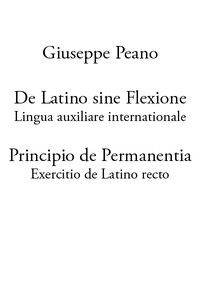
De Latino sine Flexione; Principio de Permanentia by Giuseppe Peano
Forget everything you think you know about language textbooks. De Latino sine Flexione isn't about teaching you to read Cicero. Instead, it's a bold, concise proposal from one of history's great mathematicians. Giuseppe Peano had a problem with international communication among scientists and scholars. His solution was elegantly simple: take the ancient, widely studied grammar of Latin and surgically remove all the difficult parts—the case endings, the complex verb forms. What's left is a streamlined, logical framework he believed anyone could learn in weeks.
The Story
There's no plot in the traditional sense. The 'story' is the argument itself. Peano lays out his case step-by-step. He shows examples of classic Latin texts translated into his simplified version, demonstrating how much clearer and more direct it becomes. He walks you through the new, minimal grammar rules. The entire work is an experiment and a proof of concept, wrapped up in a passionate plea for rational, global understanding. It's the blueprint for a tool meant to build intellectual bridges.
Why You Should Read It
This book is a time capsule of a specific kind of optimism. Reading it, you feel Peano's genuine belief that human conflict and misunderstanding could be reduced through a better, shared system of words. It's poignant, because we know now how that dream turned out. Beyond the history, it's just a cool intellectual exercise. Watching a master logician dissect a language and rebuild it for efficiency is fascinating. It makes you look at English, or any language you speak, and wonder, "What are *our* unnecessary complications?"
Final Verdict
This is a niche read, but a rewarding one. It's perfect for language nerds, history of science buffs, or anyone who enjoys seeing a brilliant, flawed, and beautifully clear idea presented in its purest form. It's not a long or difficult read, but it will stick with you, a quiet monument to the dream of a perfectly shared thought. If you liked the concept of Esperanto or find joy in logical puzzles applied to human problems, you'll find Peano's manifesto absolutely captivating.
This historical work is free of copyright protections. Share knowledge freely with the world.
Oliver King
1 year agoRecommended.
Noah Torres
6 months agoEnjoyed every page.
Barbara Jackson
2 years agoWithout a doubt, it creates a vivid world that you simply do not want to leave. Highly recommended.





Aiden Brown
11 months agoHigh quality edition, very readable.