
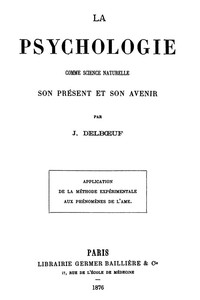
La psychologie comme science naturelle, son présent et son avenir by Delboeuf
This book isn't a story in the traditional sense. It's an argument, a proposal for a whole new way of thinking. Published in the late 19th century, it's Delboeuf's case for why psychology should stop being just armchair philosophy and join the ranks of the natural sciences.
The Story
Delboeuf sets up his stall right from the beginning. He looks at the incredible progress in fields like physics and physiology and asks: why can't we do the same for the mind? The 'plot' follows his effort to map out what a scientific psychology would look like. He talks about using experiments, precise measurements, and careful observation—tools from the lab—to study things like sensation, memory, and attention. He pushes back against the idea that the inner world is too subjective or spiritual for science. For him, if we can study a frog's nerve, we can study a human thought. The book is his blueprint for that project.
Why You Should Read It
Reading this feels like getting a backstage pass to a major intellectual shift. You're seeing the birth pangs of modern psychology. It's humbling to realize how many of our current debates—nature vs. nurture, the limits of experimentation, the relationship between brain and mind—were already being hashed out in Delboeuf's time. His writing has this earnest, determined energy. He's not just theorizing; he's practically rolling up his sleeves and saying, 'Here's how we start.' You get a real sense of the excitement and optimism of that scientific era.
Final Verdict
This book is a niche read, but a rewarding one. It's perfect for psychology students who want to understand the historical roots of their field, or for science history buffs who enjoy seeing how disciplines evolve. It's also great for anyone who likes big, foundational ideas. Be warned: it's a 19th-century academic text, so the language can be dense in places. But if you push through, you'll find a clear, passionate vision for making the study of the mind as rigorous as the study of matter. It's a snapshot of a moment when everything about understanding ourselves seemed possible.
This is a copyright-free edition. Share knowledge freely with the world.
Richard Garcia
2 months agoI appreciate the objective tone and the evidence-based approach.
George Wilson
1 year agoFinally found a version that is easy on the eyes.
Linda Williams
5 months agoI found the author's tone to be very professional yet accessible, the quality of the diagrams and illustrations (if applicable) is top-notch. A perfect balance of theory and practical advice.
Donald Perez
1 month agoThe layout is perfect for tablet and e-reader devices.









David Garcia
11 months agoRight from the opening paragraph, the emphasis on ethics and sustainability within the topic is commendable. The price-to-value ratio here is simply unbeatable.