
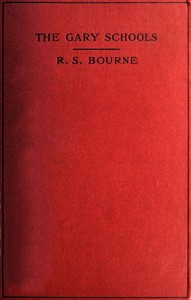
The Gary Schools by Randolph Silliman Bourne
Published in 1916, The Gary Schools is Randolph Bourne's firsthand account of a revolutionary educational experiment. The city of Gary, Indiana, built from the ground up by U.S. Steel, decided to build its school system from the ground up, too. They threw out the old rulebook.
The Story
Bourne, a sharp and curious journalist, spends time in Gary's classrooms, workshops, and playgrounds. He describes the 'platoon' or 'work-study-play' system. Instead of one teacher in one room all day, students rotated between academic subjects, hands-on shops (like printing or carpentry), and recreational activities. The school building itself was used all day, every day, by the whole community. Bourne doesn't just give us statistics; he shows us the system in action. We see the buzz of a functioning print shop run by students, the focus in a science lab, and the debate over whether all this activity is truly educating children or just keeping them busy. The 'story' is the tension between this beautiful, efficient theory and the complicated reality of making it work for thousands of kids from diverse backgrounds.
Why You Should Read It
What grabbed me was Bourne's voice. He's excited but not fooled. He's clearly impressed by the ambition and the energy, but he notices the cracks—the huge classes, the teachers stretched thin, the question of whether every child needs to be an industrial apprentice. Reading this today is eerie. We're still arguing about vocational training vs. college prep, school funding, and how to use school buildings after 3 PM. Bourne captures the core hope that drives education reform: the belief that we can design a system that truly prepares kids for life. He also, without maybe meaning to, shows how hard that is to pull off. It's a hopeful and sobering look at American idealism.
Final Verdict
Perfect for anyone interested in the history of ideas, education, or how America tries to reinvent itself. If you've ever been a student, a teacher, or a parent, you'll find something fascinating here. It's not a novel; it's a piece of passionate journalism that reads like a time capsule from a crossroads. You'll come away thinking, 'Some things never change,' and 'Wow, they really tried something completely different.' A short, compelling read for curious minds.
This work has been identified as being free of known copyright restrictions. Access is open to everyone around the world.
Jennifer Thompson
1 month agoRight from the opening paragraph, the inclusion of diverse viewpoints strengthens the overall narrative. It’s hard to find this much value in a single source these days.