
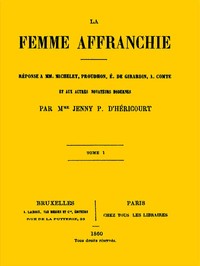
La femme affranchie, vol. 1 of 2 by Madame d' Héricourt
Let's set the scene: France, the mid-1800s. The debates about democracy and human rights are loud, but they almost always leave out half the population—women. Into this fray steps Madame d'Héricourt, a name history nearly forgot. ‘La femme affranchie’ isn't a novel with a plot in the traditional sense. Instead, it's a powerful, two-volume manifesto structured as a series of responses and critiques.
The Story
Think of this book as a brilliant, lengthy debate. D'Héricourt directly challenges the leading male thinkers of her day, like the philosopher Auguste Comte and the anthropologist Pierre-Joseph Proudhon. These men published works arguing that women were biologically and intellectually destined for subservience, confined to the home. D'Héricourt takes their own words, their own scientific references, and turns them inside out. She uses data, historical examples, and cold, hard logic to prove that what they call 'nature' is really just prejudice dressed up in fancy language. Each chapter tackles a different myth—about women's brains, their physical strength, their capacity for reason—and systematically dismantles it. The 'story' is the thrilling intellectual journey of watching her build an airtight case for total equality.
Why You Should Read It
First, her voice is incredible. She's witty, she's angry, and she's fiercely intelligent. You can feel her frustration leaping off the page, but it's always channeled into clear argument. Reading her dissect a sexist claim with surgical precision is deeply satisfying. Second, it’s a shocking mirror. You'll read arguments from the 1860s and catch yourself thinking, ‘Wait, I’ve heard a modern version of this.’ It shows how deeply rooted these ideas are, and how long women have been fighting them with facts. It’s not a dry history lesson; it’s a masterclass in debate from a pioneer who refused to be silent.
Final Verdict
This is a must-read for anyone interested in feminism, history, or the power of a good argument. It's perfect for readers who loved the foundational ideas in something like Mary Wollstonecraft's A Vindication of the Rights of Woman but want to see the fight continue into a more modern, scientific age. Be prepared for a dense read—it's a philosophical text—but one that pays off with stunning insights on every page. Madame d'Héricourt is a hidden hero of the movement, and her book is a powerful reminder that the fight for equality has always been a battle of wits.
This text is dedicated to the public domain. Preserving history for future generations.
Liam Davis
1 year agoClear and concise.
William Brown
2 years agoSurprisingly enough, it creates a vivid world that you simply do not want to leave. One of the best books I've read this year.
Ethan Torres
1 year agoClear and concise.






Edward Davis
1 year agoI have to admit, the narrative structure is incredibly compelling. I would gladly recommend this title.