
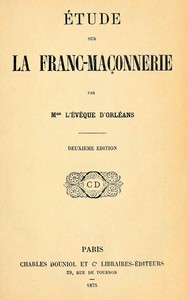
Étude sur la Franc-Maçonnerie by Félix Dupanloup
Published in 1855, Étude sur la Franc-Maçonnerie isn't a novel or a standard history. It's a polemic, a public argument written by Félix Dupanloup, the Bishop of Orléans. He was a major figure in 19th-century French Catholicism, and this book is his clear, forceful condemnation of the Freemasons.
The Story
There's no traditional plot here. Instead, think of it as Dupanloup building a legal case. He structures his 'study' as a direct address, arguing that Freemasonry is fundamentally incompatible with Catholicism and a destabilizing force for society. He attacks their secret oaths, their independence from religious authority, and what he sees as their natural tendency to oppose the Church. For Dupanloup, this isn't just a philosophical difference; it's a active, spiritual battle. The book reads like a battle cry from one side of a deep cultural divide, outlining all the reasons why, in his view, good Catholics must reject and resist Masonic influence.
Why You Should Read It
What's compelling is the raw perspective. This isn't a balanced, modern analysis. It's one man's deeply held conviction, laid bare. You get to see the exact language and reasoning a leading cleric used to define an 'enemy.' It helps you understand the historical fear and opposition these societies faced from established institutions. Reading Dupanloup's passionate warnings—which likely felt utterly logical to his audience at the time—makes you think about how groups outside the mainstream are labeled and opposed in any era. It's a short, concentrated dose of 19th-century ideological conflict.
Final Verdict
This book is a niche gem, but a fascinating one. It's perfect for history buffs interested in the clash between religion and secularism in 1800s Europe, or for anyone curious about the original arguments against secret societies. It's also great for readers who enjoy primary sources and want to hear a historical figure's voice directly, unfiltered by later interpretation. If you're looking for an objective history of Freemasonry, this isn't it. But if you want to understand one powerful side of a centuries-old debate, Dupanloup's 'Étude' is a clear, forceful, and surprisingly accessible window into the past.
This masterpiece is free from copyright limitations. Knowledge should be free and accessible.
Nancy Anderson
2 years agoText is crisp, making it easy to focus.
Mark Lee
8 months agoAfter finishing this book, the author's voice is distinct and makes complex topics easy to digest. I will read more from this author.
George Hernandez
5 months agoI came across this while browsing and it provides a comprehensive overview perfect for everyone. A valuable addition to my collection.
Melissa Davis
5 months agoI have to admit, the plot twists are genuinely surprising. Truly inspiring.







Oliver Allen
1 year agoGreat digital experience compared to other versions.